
 0
0
 0
0
Trade between Africa and the United States continues to grow across a wide range of sectors, including chemicals, industrial products, mining, manufacturing, laboratory supplies, paints, aerosols, batteries and other products that may be classified as hazardous materials during transport. For African companies that export these products to the United States, compliance with international transport rules alone is not always sufficient. Once hazardous materials enter the United States transport system, the requirements of the U.S. Department of Transportation become highly relevant.
These requirements are mainly contained in Title 49 of the Code of Federal Regulations, commonly known as 49 CFR. For companies in English-speaking African countries such as South Africa, Nigeria, Ghana, Kenya, Uganda, Tanzania, Zambia, Zimbabwe, Botswana, Namibia, Malawi, Rwanda, Liberia, Sierra Leone, The Gambia, Lesotho and Eswatini, understanding the basic principles of 49 CFR can be particularly valuable when exporting dangerous goods to the American market.
Many of these countries already have strong international trade links and logistics sectors that operate in English. This makes the United States an accessible commercial market, but it also means that exporters must understand not only international rules such as IMDG or IATA, but also the specific requirements that apply within the United States.
Understanding the U.S. Hazardous Materials Regulations
The United States regulates the transport of hazardous materials through the Hazardous Materials Regulations, or HMR. These regulations are administered by the Pipeline and Hazardous Materials Safety Administration, commonly known as PHMSA, and are mainly found in 49 CFR Parts 171 through 180.
The regulations cover a wide range of subjects, including classification, proper shipping names, UN and NA numbers, hazard classes, packing groups, packaging requirements, marking, labelling, placarding, shipping papers, emergency response information, security and training.
One important point for African exporters is that 49 CFR is not only relevant to companies physically located inside the United States. In certain circumstances, companies located outside the United States can also have responsibilities when they prepare hazardous materials for transportation into the American market.
This is especially relevant when an African company classifies a product, selects a packaging, applies hazard labels, prepares transport documentation or otherwise offers a hazardous material for transport to the United States. In practice, many compliance decisions are made long before the shipment arrives at an American port or airport.
A company in Kenya, South Africa or Nigeria may therefore already be making decisions that directly affect whether the shipment complies with U.S. hazardous materials requirements.
US DOT Hazmat Training Africa?
International Dangerous Goods Rules Are Not Always Enough
Many African exporters are already familiar with international transport regulations. Companies involved in sea freight may work according to the IMDG Code, while companies transporting dangerous goods by air may use the ICAO Technical Instructions and the IATA Dangerous Goods Regulations.
These systems provide an important foundation, but they are not identical to 49 CFR.
There are many similarities between international dangerous goods regulations and the U.S. system, particularly in areas such as hazard classes, UN numbers, packaging and labelling. However, the United States also has its own terminology, procedures, exceptions and administrative requirements.
A person who is experienced with the IMDG Code may understand how to classify dangerous goods and identify the correct UN number, but may be unfamiliar with the structure of the U.S. Hazardous Materials Table in §172.101, the use of NA numbers, specific placarding rules or certain requirements relating to shipping papers.
These differences become particularly important when goods continue their journey by road or rail after arriving in the United States. A shipment may initially be prepared for international maritime transport, but after unloading from the vessel it enters the domestic U.S. transport system.
At that stage, the requirements of the U.S. Department of Transportation become increasingly important.
For this reason, companies that regularly export hazardous materials to the United States benefit from having personnel who understand both the international regulations and the basic structure of 49 CFR.
Why Training Is Important for African Exporters
Dangerous goods are not always obvious. Many products that appear to be ordinary commercial goods may be regulated as hazardous materials during transport.
Typical examples include paints, adhesives, solvents, cleaning products, aerosols, perfumes, alcohol-based products, laboratory chemicals and lithium batteries. Even machinery or equipment may contain hazardous components such as batteries, compressed gases or flammable liquids.
The personnel responsible for export documentation, warehousing or logistics therefore need to understand when a product may fall under hazardous materials regulations.
Under 49 CFR, training is closely linked to the actual tasks performed by employees. The concept of function-specific training is particularly important. Employees should be trained in the regulatory requirements that apply to the functions they perform.
For example, an employee responsible for classifying a hazardous material requires different knowledge from an employee who only prepares shipping papers. Likewise, a warehouse employee who marks and labels packages may need training that is different from that of a logistics manager who arranges transport.
For African exporters, this means that hazardous materials knowledge should not be limited to the HSE department. Export managers, supply chain personnel, warehouse supervisors, shipping clerks and logistics coordinators may all perform activities that influence regulatory compliance.
A basic understanding of U.S. hazardous materials regulations can therefore help companies prevent errors before the shipment leaves Africa.
Training Requirements under 49 CFR
The training requirements for hazmat employees are mainly described in 49 CFR §172.704. They include general awareness or familiarization training, function-specific training, safety training and security awareness training. Additional security training may also apply to employees working for companies that are required to maintain a hazardous materials security plan.
Training is generally required to be repeated periodically. Under the U.S. system, recurrent training is normally required at least once every three years.
For companies outside the United States, the exact application of these requirements depends on the activities being performed and the role of the company within the transport chain. It is therefore important to understand that a general online course provides regulatory awareness and knowledge, but the employer remains responsible for determining whether additional function-specific instruction is necessary.
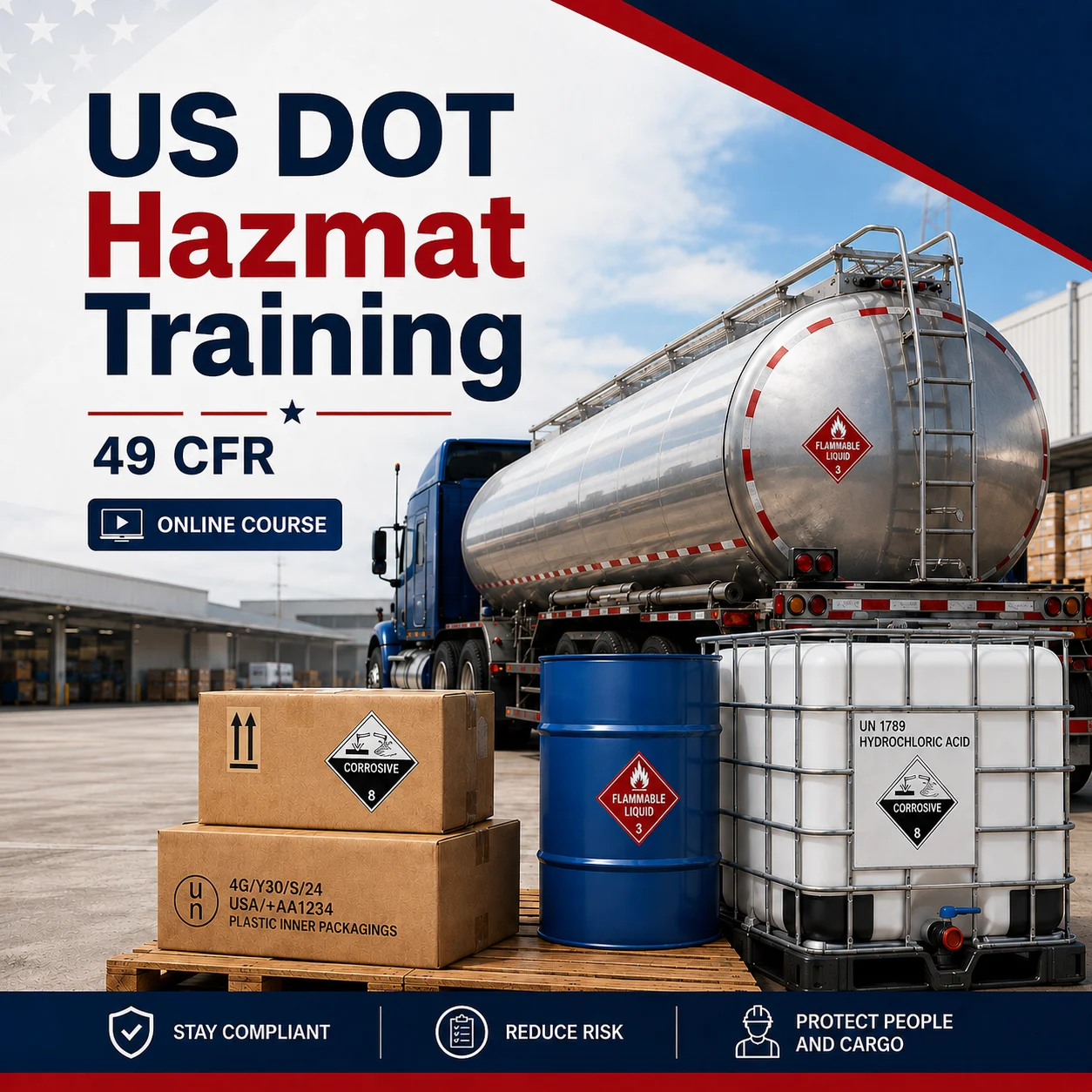
The US DOT Hazmat Training (49 CFR) – USA available through SafetyNet Africa is designed to provide employees with a practical introduction to the U.S. hazardous materials system.
The training covers important subjects such as the Hazardous Materials Table, UN and NA numbers, Proper Shipping Names, hazard classes, packing groups, packaging, markings and labels, limited quantities, placards, shipping papers, safe handling, personal protective equipment, incident response, security awareness and general compliance responsibilities.
For African companies that work with U.S. customers, freight forwarders, shipping lines or logistics providers, this knowledge can make communication easier and reduce misunderstandings during the preparation of shipments.
Building Compliance into the Export Process
The most effective way to manage U.S. hazardous materials compliance is to start before the shipment leaves Africa.
If an incorrect classification is used, the wrong packaging is selected or essential transport information is missing, the problem may follow the shipment throughout the supply chain. Correcting these issues after the cargo has arrived in the United States can cause delays, additional handling costs and operational complications.
Companies that understand the basic principles of 49 CFR are better able to identify problems at an earlier stage.
This is particularly useful for exporters in countries such as South Africa, Nigeria, Kenya, Ghana, Tanzania, Uganda, Zambia, Zimbabwe, Botswana and Namibia, where international logistics and industrial exports play an important role in the economy.
For these companies, knowledge of U.S. hazardous materials regulations should not be seen purely as an American compliance issue. It can also be considered an export competence.
Employees who understand the expectations of the destination country can prepare documentation more accurately, communicate more effectively with U.S. customers and logistics partners and reduce the likelihood of shipments being delayed because of regulatory issues.
Exporting dangerous goods successfully requires more than moving a product from one country to another. It requires understanding the regulatory systems that apply throughout the entire transport chain.
For African companies that already export to the United States, or that are planning to enter the American market, US DOT Hazmat Training based on 49 CFR provides a valuable foundation for safer and more compliant international trade.
The key principle is simple: compliance with U.S. hazardous materials regulations does not begin when the container reaches an American port. In many cases, the decisions that determine whether a shipment will be compliant are made much earlier, at the factory, warehouse, laboratory or export office in Africa.


