
 0
0
 0
0
The IMDG Code Amendment 42-24 marks a new chapter in maritime safety. Beginning 1 January 2025, companies can adopt the new edition voluntarily, with mandatory compliance by January 2026.
For many shipping and logistics companies, IMDG 2025 compliance is not just about meeting regulation. It’s about future-proofing safety, reducing delays, and strengthening global trust. Those who act early will gain an operational edge and avoid last-minute pressure as enforcement draws closer.
According to the International Maritime Organisation (IMO), over 60% of DG-related incidents are caused by documentation or training errors. This update aims to close those gaps with clearer classification, digital documentation guidance, and updated training standards.
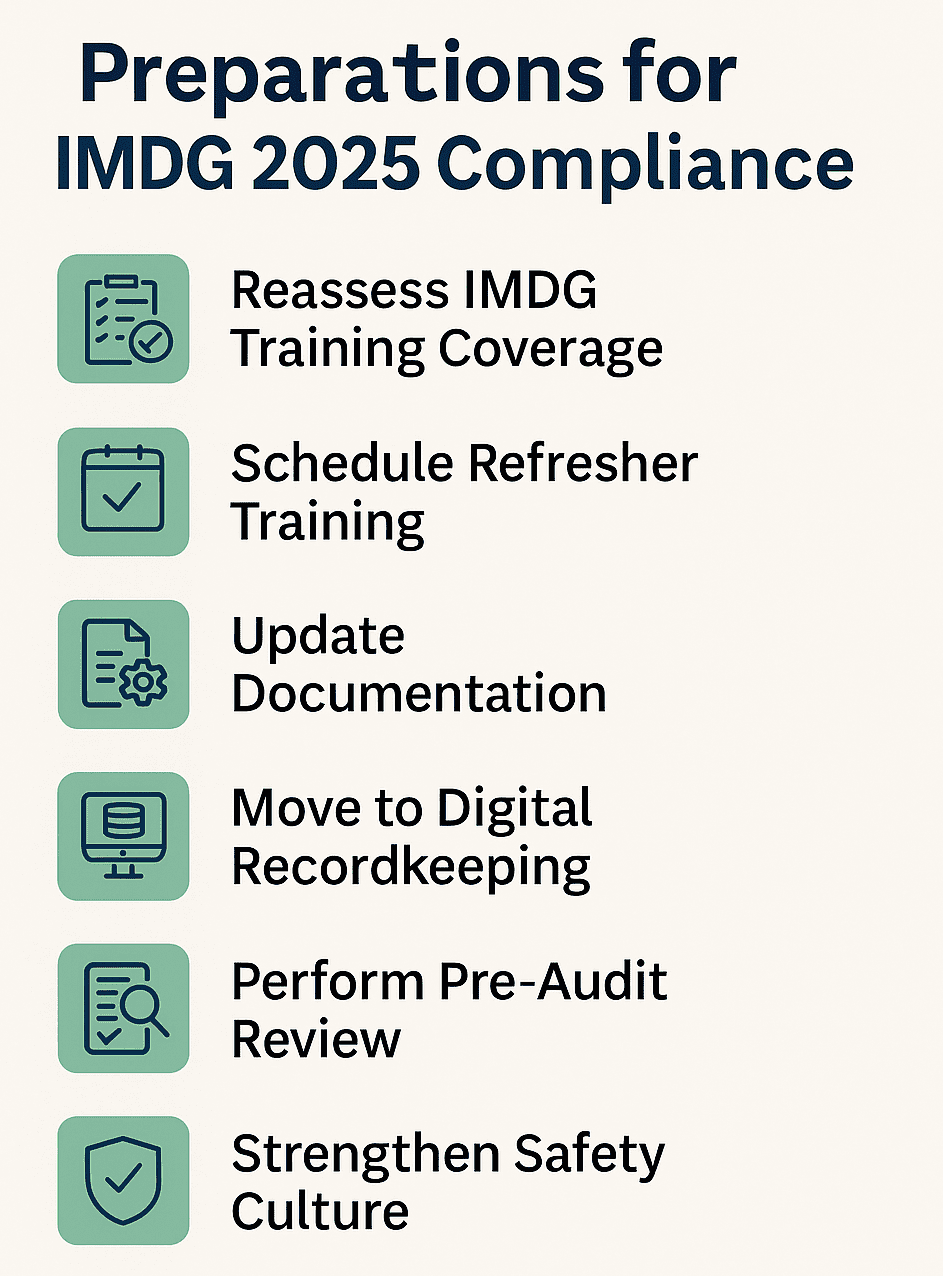
Step 1: Reassess Your IMDG Training Coverage
Chapter 1.3 of the IMDG Code makes it clear – training is mandatory for all shore-based personnel involved in dangerous goods transport. Yet many organisations still overlook support roles such as loaders, port staff and documentation teams.
To start your IMDG 2025 compliance journey, run an internal training audit:
-
Check every role involved in DG transport or documentation
-
Verify certificate expiry dates and trainer credentials
-
Confirm refresher cycles align with the 2-year IMDG requirement
➡️ Download: IMDG Training Matrix & FAQ (2025 Edition)
Companies that review early can prevent compliance gaps during audits and keep records clean for inspection.
Step 2: Schedule Early Refresher Training
Even if your team has valid certificates, they may predate Amendment 42-24. Schedule refresher training in early 2025 to cover key updates:
-
New and reclassified UN numbers
-
Lithium battery handling and testing revisions
-
Adjusted packing and marking provisions
-
Clarity on marine pollutant definitions
Digital courses allow flexible delivery and audit-ready tracking. SafetyNet International’s IMDG E-Learning courses offer certification aligned with the latest code and can be rolled out across multiple sites.
Step 3: Update SOPs and Documentation
Amendment 42-24 includes terminology and procedural refinements that should be reflected in your operational manuals. Review and update:
-
Dangerous Goods Declarations (DGD)
-
Emergency Response Instructions
-
Packing and segregation procedures
-
Hazard labelling and placarding templates
Ensure that every controlled document references “IMDG Code 2025 (Amendment 42-24).”
This simple step demonstrates awareness and alignment during audits.
(External link: IMO – Dangerous Goods Regulations)
Step 4: Move Toward Digital Recordkeeping
The move from paper to digital is one of the biggest operational upgrades under IMDG 2025.
Companies still managing training and shipment data in folders risk missing deadlines, misplacing records, or failing audits.
Digital systems offer:
-
Centralised training logs and certificate databases
-
Automated renewal reminders
-
Easy sharing with clients or authorities
-
Secure storage and instant retrieval
Migrating to a digital recordkeeping toolkit by mid-2025 ensures a smooth transition before enforcement.
➡️ Resource: Digital Compliance Recordkeeping Toolkit
Step 5: Conduct a Pre-Audit Readiness Review
Internal audits help identify weaknesses before inspectors do.
A pre-audit should review:
-
Expired certificates or incomplete refresher logs
-
Incorrect or outdated labels on packaging
-
Training records missing job-role alignment
-
Documentation inconsistencies across sites
Running a review by June 2025 gives your teams time to resolve findings and demonstrate due diligence.
➡️ Download: Audit-Ready IMDG Training Checklist
Step 6: Strengthen Your Safety Culture
True compliance goes beyond checklists.
An embedded safety culture ensures every team member understands how their role affects safety and reputation.
You can build this culture by:
-
Recognising staff who identify or report DG issues
-
Conducting monthly toolbox talks using real scenarios
-
Integrating IMDG awareness into onboarding and team briefings
According to the UK Maritime and Coastguard Agency (MCA), building proactive safety cultures can reduce incident rates by up to 40%. This proves that compliance isn’t a cost — it’s a performance advantage.
(External link: UK MCA – Maritime Safety Guidance)
Strategic ROI of IMDG 2025 Compliance
Leading maritime operators see IMDG 2025 compliance not as regulation, but as an opportunity.
Those who implement digital systems and training updates early report measurable results:
|
Benefit |
Impact |
|---|---|
|
Reduced port delays |
Up to 30% faster inspections |
|
Fewer non-compliance fines |
Savings of £5,000–£15,000 per incident |
|
Faster training verification |
< 10 minutes vs hours manually |
|
Improved reputation |
Stronger trust with global carriers |
Early action builds resilience and gives your brand a competitive edge in the global logistics chain.
Common Mistakes to Avoid
-
Assuming previous certificates remain valid post-2024.
-
Overlooking support roles such as warehouse or documentation teams.
-
Relying on outdated templates or forms.
-
Using spreadsheets instead of digital record systems.
-
Treating compliance as a one-off task instead of continuous improvement.
Avoid these pitfalls and your transition to IMDG 2025 will be smooth and verifiable.
FAQ (Schema-Optimised for Rank Math)
Q: When does IMDG Code 2025 become mandatory?
A: The IMDG Code Amendment 42-24 becomes mandatory from 1 January 2026, with optional implementation starting 1 January 2025.
Q: Who must complete IMDG 2025 compliance training?
A: All shore-based personnel handling, packaging, documenting, or managing dangerous goods must receive function-specific training under Chapter 1.3 of the Code.
Q: Can IMDG training be completed online?
A: Yes. Digital IMDG courses are fully recognised and ideal for multisite operations, enabling faster tracking and audit-ready certificates.
Resources for IMDG 2025 Compliance
Explore SafetyNet International’s free compliance tools designed to make IMDG 2025 transition seamless:
-
IMDG Training Matrix & FAQ (2025 Edition) – Clarify role-specific obligations.
-
Audit-Ready IMDG Checklist – Self-audit your training compliance.
-
Digital Recordkeeping Toolkit – Manage documentation securely.
-
IMDG 2025 Readiness Guide – Full overview of new rules, timelines, and best practices.
 Final Thoughts
IMDG 2025 compliance represents a shift toward smarter, data-driven safety across maritime operations.
By preparing now updating training, digitising records, and embedding a culture of accountability — operators will move into 2026 fully confident in their systems and workforce.
At SafetyNet International, we help maritime organisations achieve that confidence through certified IMDG e-learning, custom training plans, and free digital compliance tools.
Start your readiness journey today at www.imdg-course.com



- Step 1: Reassess Your IMDG Training Coverage
- Step 2: Schedule Early Refresher Training
- Step 3: Update SOPs and Documentation
- Step 4: Move Toward Digital Recordkeeping
- Step 5: Conduct a Pre-Audit Readiness Review
- Step 6: Strengthen Your Safety Culture
- Strategic ROI of IMDG 2025 Compliance
- Common Mistakes to Avoid
- FAQ (Schema-Optimised for Rank Math)
- Resources for IMDG 2025 Compliance
- Final Thoughts